
Angela Carter (1940–1992) is one of the boldest and most original postmodern writers. Her work draws on an eclectic range of themes and influences, from gothic fantasy, traditional fairy tales, Shakespeare and music hall, through Surrealism and the cinema of Godard and Fellini. Carter’s work breaks many long-established taboos, especially when it comes to feminism. She makes the women in control of their own narratives. Since in fairy tales the feminine voice was not heard for centuries, her stories have been an original attempt to give the women their voice back for the first time. She narrates from different angles the same story using the feminine character perspective to show the mysteries of the feminine psyche.
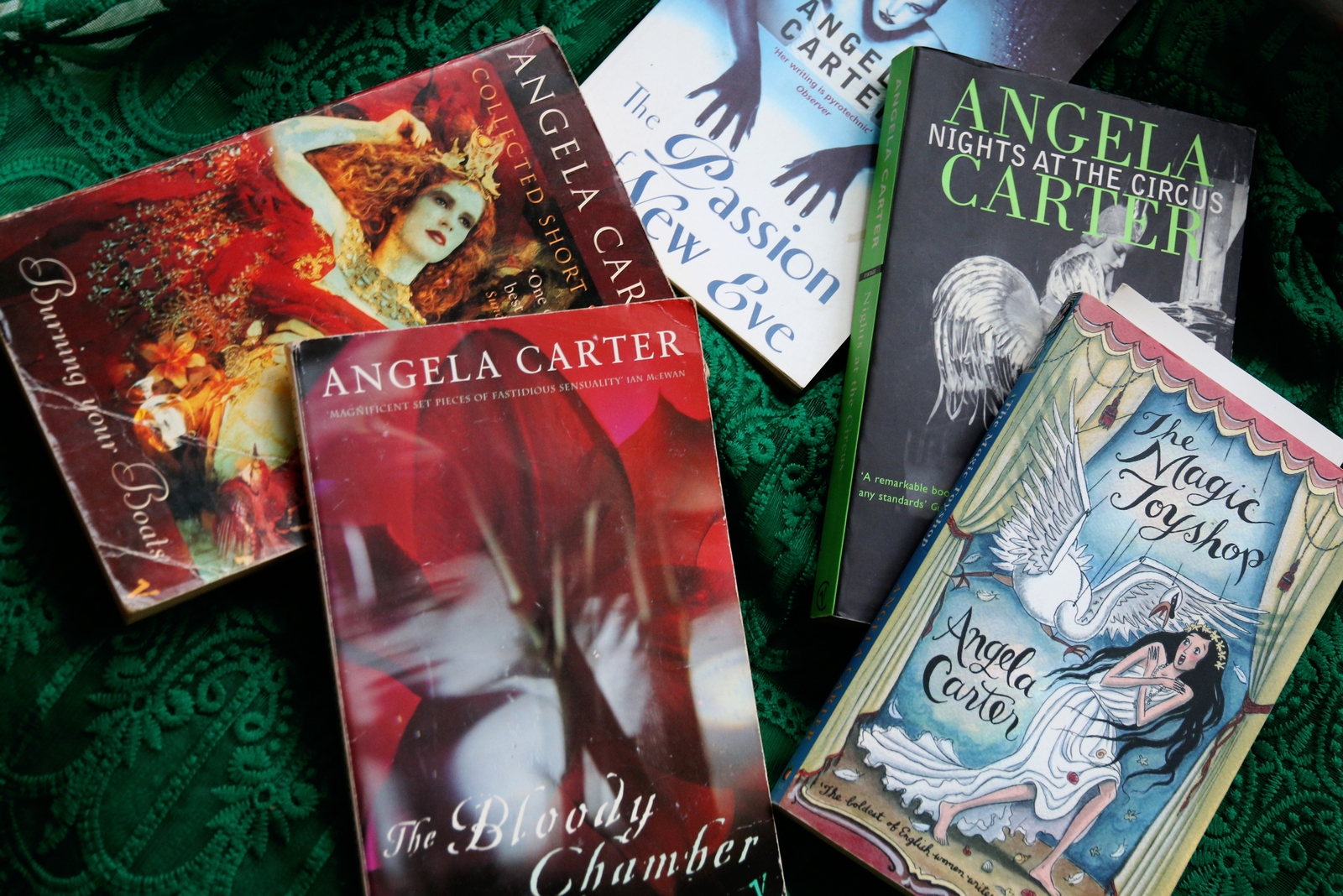
Such a story is Bloody Chamber that is a rewriting of the fairy tale “Bluebeard”. It uses the first person narrative, and the perspective is the girl’s. The girl who gets married to a rich and older man.
The story begins with her expectations, preparations for the journey. The text exhibits a high level of intimacy as if it was a diary written by an innocent girl who confesses her expectations, her fears and thoughts about marriage and the man who chose her.
She is the main character in the story and all the others are seen through her eyes: her mother first, the man who has become her husband, the blind piano-tuner whom he brings to his castle and who would fall in love with her by listening to her playing the piano. She is seventeen, an innocent and sensitive girl with love for music. She is self-conscious when it comes to her feelings and thoughts. She feels the marriage changes her: “I was not afraid of him; but of myself, to think he might have chosen me because in my innocence he sensed a rare talent for corruption”.

The text is full of hints as if she anticipates the end: the red rubies choker, his gift to her, the feline-like features he has, the double meaning words, the repetition of the word “soon”. Half of the text is the anticipation of the wedding night when he would take her virginity in a barbaric way, the sexual elements are extremely rich and seductive. Her initiation into the sex life is done step by step. Everything he does is ritualistic: the disrobing of bride, the love they make, his gifts and smiles, and the final gift, giving away the keys to his castle. He is tempting her all the time, playing with her. He senses she is curious and there is only certain path she could take, the path where he leads her to. The other half is an anticipation of the murder. This is what he longs for. He had been married three times before, all wives died and the bodies were never found. In death those women become his for ever. Death is the last initiation, it is the eternal love.

There are a lot of metaphors: the mirrors, reflections that multiply the reality, making a simple act of love-making, an act of perversion, the lilies that symbolize death and also sexuality. Eros and Thanatos as in the Greek mythology are linked together. Murder is the ultimate sexual perversion. This is what the girl will understand by entering the forbidden room, the “Bloody chamber”: “Each time I struck a match to light those candles round her bed, it seemed a garment of that innocence of mine for which he had lusted fell away for me”. She discovers each wife has been murdered in a different way. It was like he was an artist of death. That feature of his is also anticipated when he talks to her about a painting: ‘Sacrificial Victim”. Her feminine intuition will tell her how he intends to murder her: by beheading. That choker he gave her was one of the first preparations he made for the ultimate act.

He comes back and she waits for him knowing there is no escaping death. But this story has a happy-end because her brave mother would shoot him dead and she would inherit his money and castle.
The feminist twist of the end is unexpected.
The story is rich in style and extremely seductive.
Elena Petrovan
