Review of ”The Girl, the Wolf, the Crone” by Kelly Wells.
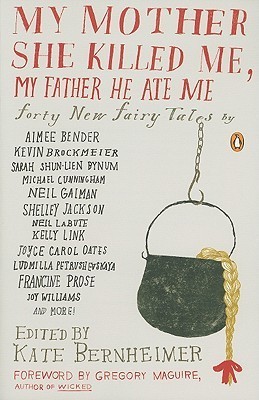
Kellie Wells, ”The Girl, the Wolf, the Crone”, in Carmen Giménez Smith et al. My Mother She Killed Me, My Father He Ate Me: Forty New Fairy Tales. Penguin Books, 2010, pg. 353–360
Plot summary:
Once upon a time there was a woman who always carried around a loaf of bread. One day, she decided to give the loaf of bread to her daughter, for her to give to a sickly wolf. The girl hit the road until she met a forked road “where everyone chooses wrongly”. One road was paved with spoons and the other one was littered with sausages. The girl meets a woman who gives her a warning that she already had chosen the wrong road even though the girl did not make her choice yet. The girl chose the one with the spoons and carried on her way. Meanwhile, the woman arrived to the wolf before the girl did, and so, she ate the sickly wolf, spat its bones on the bed and got inside the wolf’s skin. When the girl arrived to the wolf’s place, she noticed the bones and realized that something was wrong. Still, she sat on the bed together with the woman in the wolf’s skin. The latter ate the girl and swallowed her alive. One huntsman came to the rescue, cut the belly of the wolf and got the girl out, together with her loaf of bread. In the end, the woman is presented again as being the mother of the girl.
Kellie Wells is a teacher and a writer of short stories and novels. With The Girl, the Wolf, the Crone, she rewrote the story of Little Red Riding Hood, presenting it as a corrupt version of the story by changing the gender roles. She states that with this version, she tried to make it “kind of garishly lit, demi-lucid dream”, because fairy-tales are fiction after all, and fiction allows anything.
The title of the fairy-tale is suggestive enough as it presents the protagonists of the main action: the girl who travels to the sickly wolf, the wolf itself and the crone – the mother of the girl. Crone can also be seen as alternative way when referring to an old person. It does sound like a fairy-tale and it does refer to the text itself.
The characters are: the girl – who is asked by her mother to travel with a loaf of bread to a sickly wolf. As obedient as Little Red Riding Hood was, she obeyed her mom and tried to stay in her path to succeed in her mission. At the end the girl is eaten by the wolf, who is actually her mother. The huntsman though saves the girl from the wolf’s belly. The wolf portrays the animal that just follows his animal instincts. The wolf gets tricked by the woman, who eats him. The Woman (or the Crone) – the mother of the girl, the woman the girl meets at the forked road, the actual predator who eats the wolf and the girl. She gets killed at the end by the huntsman.
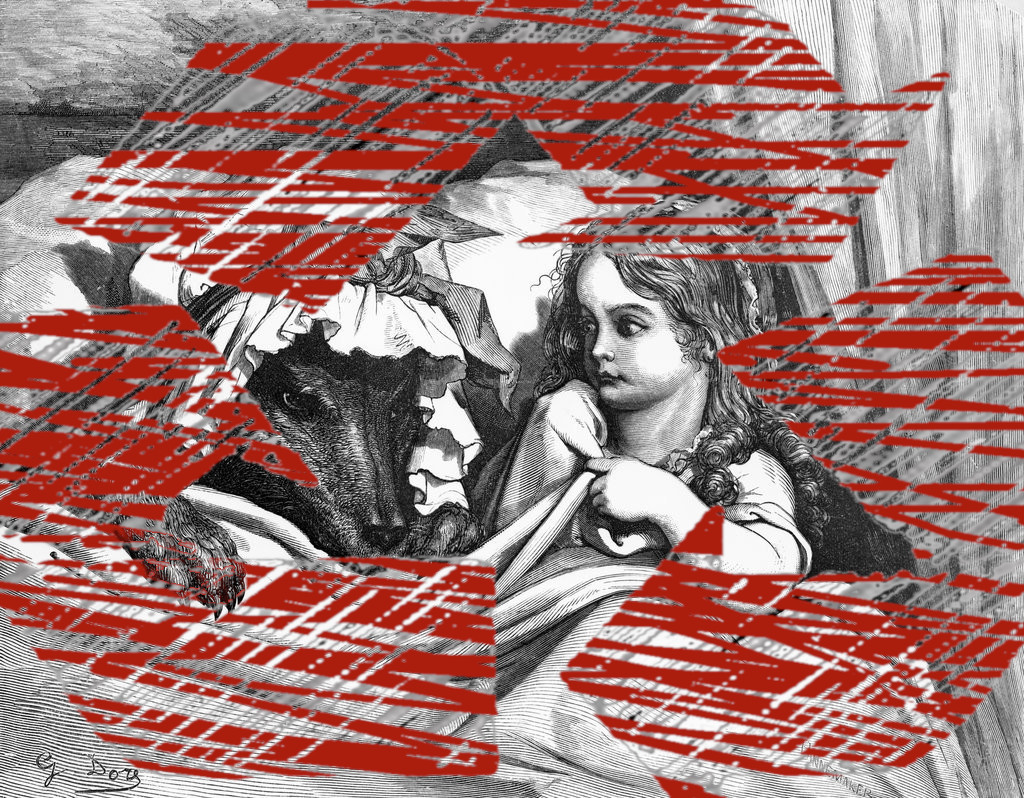
Based on Gustave Doré’s famous illustration to the tale, this collage by © Storynook Pooka suggests both the recycling of the tale and the corruption of the original food chain.
The described epoch and the time itself is indeterminate and not even specified or referred to in any way. We can only assume that the story presented by Kellie Wells happened somehow in the same or approximate time as Little Red Riding Hood. The antiquated language though may give us a little hint of the time: “Behold, he is at hand that doth betray me” or “to better to chide with you, lovey”, as nobody would express themselves orally in that manner anymore, which makes us think of a few centuries before.
The atmosphere seems to be fantastic in the story, just as every other fairy-tale.
The text itself is a parody, a rewriting of Little Red Riding Hood, but in which the predator is the girl’s mother. The gender roles are reversed: the wolf and the girl are the victims, the grandma is not present, but the huntsman is – playing the same role as savior in the end, just as he did in the original fairy-tale (the Grimm version though, not Perrault’s version).
The text has the characteristics of a fairy tale: the initial formula “More than once there was […]”, the stereotyped characters, it presents elements of fantasy or fantastic, the marvelous is also present, good and evil characters are defined (though there is a twist, as the predator is actually the crone, and not the wolf), there is a clearly defined climax or resolution (with the presence of the huntsman who kills the wolf and implicitly the crone who is inside its skin) and there is a happy ending (even though this is not always the case in fairy-tales).
The similar fairy-tales and the ones which this story playgiarized are indeed Little Red Riding Hood and Little Red Cap by Charles Perrault and Grimm brothers.
This story does not take many liberties from the original fairy-tale ideas. It does include some functions met in Vladimir Propp’s functions of the fairy-tales, the initial situation, the departure, the reconnaissance, the trickery, the exposure and the punishment. It has the main features of a fairy-tale, therefore we cannot say that they are not according to the fairy-tale’s logic.
This text is connected with other texts through the prism of the subject: the distortion of the classic fairy-tale regarding a girl, a wolf, a huntsman and a grandma: Little Red Riding Hood and Little Red Cap. The allusion of the text is pretty obvious and mocking in some way by reversing the roles. We have here parody, and not pastiche, as the text mocks in a way the original fairy-tales and it sees it in a ridiculous and absurd way.
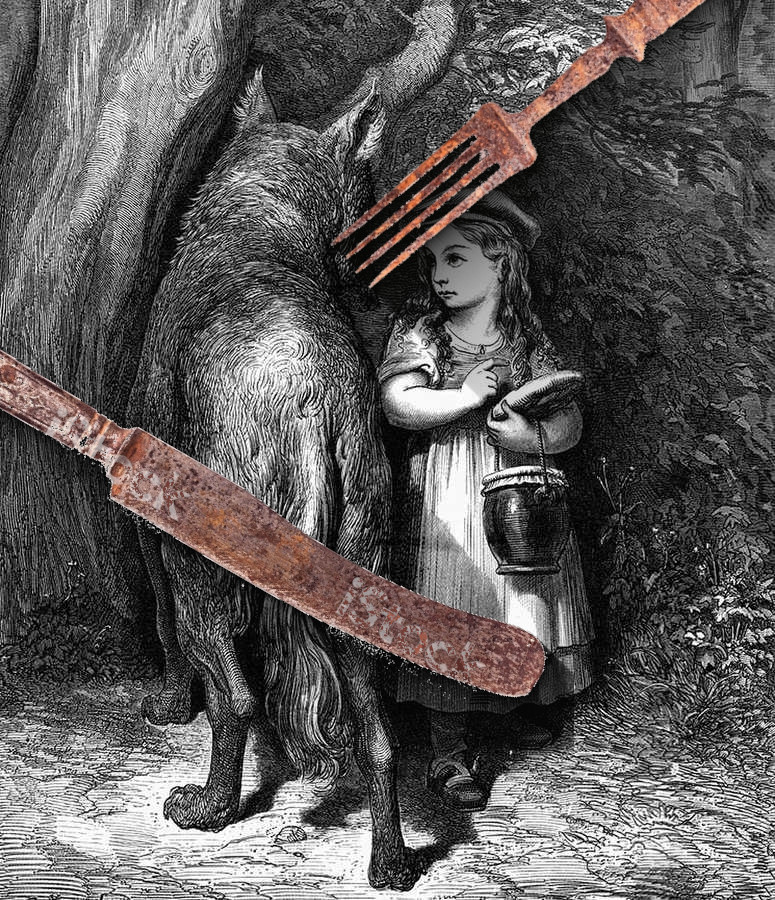
(Collage © Storynook Pooka based on Gustave Doré’s illustration to Perrault)
The author seems to be very distant of the story itself, she does not include herself or adopt the language or facts presented in the text. She uses reported speech and portrays the role of the distant teller of the story, not including subjectivity or personal opinions and thoughts into it, but only presenting it as it happened. Honestly, I cannot find any parts that seem to address specifically to contemporary audience.
Kellie Wells does not try at all to introduce herself in the story, nor personal opinions or thoughts, she simply presents the facts as they are and give us the story the way you would read it to you child at night before bedtime. Not having direct implications from the author, she does not intrude in the text, she is more as an ancient and tries to come close to the original fairy-tale, by doing so.
The morality of the tale would be: Be wary of others, the ones closest to you, as the girl is actually eaten by her own mother, in the skin of the wolf. The morale is an implicit one, as you are the one who must deduct it from the story. There isn’t much room of subjectivity when it comes to the morale of the story, I believe it is applied to everyone who read the story, and therefore it does come from the conventional wisdom.
It does support the traditional methods of the socialization of children, they are the ones who get in trouble in fairy-tales (think of Hansel & Gretel, Jack with his beanstalk, Little Red Cap, Goldie Locks, Pinocchio) and therefore the lesson is for them to learn mostly. We can learn as well (if we haven’t until this age) from the stories. It is not subversive and the text does not present us a Utopia, but neither a Dystopia.
The elements of reversal happen only in the case of the gender roles: the crone/woman is the predator — role taken by the wolf in original fairy-tale. The girl remains a victim; but the novelty is that this time the wolf is also a victim; the huntsman: plays the same part, that of the savior. Their social class seems to be middle or low (but not bottom low), as the loaf of bread that the woman keeps carrying around seems to be valuable (and who could cherish that much a loaf of bread, if not the poor?).
The style of the text is simple, not sophisticated, only filled with old terms, not in style today: “Behold, he is at hand that doth betray me, croaked the woman’s belly. She was having a little trouble restraining her feral anatomy, and she put a hand to her complicated crotch and her befurred breasts and gave everything a shake and an upward tug. Oof, went her stomach.”
It is pretty much mythical, and nothing contemporary that I could notice… and not very allusive, though there is a passage that made me reread it three times in order to understand it, and maybe I could not even get it right by that time: “The girl, with a face like a rusted skillet, clutched the bread, and when she saw the huntsman, she went, stem to stern, red as the end of the world; the huntsman took one look at the girl and thought Bolshevik and decided no brazen-faced rose that rutilant was worth deflowering.” It is kind of ambiguous and possibly sexual…?! Not really sure how to interpret this…
Another familiar passage, similar to the one in the original fairy-tale might be: “What opposable thumbs you have, wolf!” bleated the girl, who began to fear that this blue and breasted creature was not all that he seemed, this womanly wolf that smelled vaguely medicinal, giving off an odor of vitamins, blood, and moldering roses. And thumbs, he smelled of thumbs!”
The audience of the text could be young adults, but the author’s audience does not seem to be very clear from the text. We have that morale at the end of it (which is personal and subjective and not applicable for everyone) which could indicate that the story is meant for children, but is it though? As an adult, I could not see a reference towards us, adults, but still, honestly I would not give this text to children to read, it simply seems too me vulgar and not suitable.
The author does not seem to try hard to capture the audience into the narrative, but the reader is given multiple chances of interpreting it, especially the ending, which is ambiguous and open to personal interpretations.
References:
Smith, Carmen Giménez et al. My Mother She Killed Me, My Father He Ate Me: Forty New Fairy Tales. Penguin Books, 2010, pg. 353–360
For Vladimir Propp’s functions of the fairy-tales: <https://tvtropes.org/pmwiki/pmwiki.php/Main/ProppsFunctionsOfFolktales>
For the Aarne-Thompson classification system of the fairy-tales: <http://www.mftd.org/index.php?action=atu>
Octavian Ciprian Major