
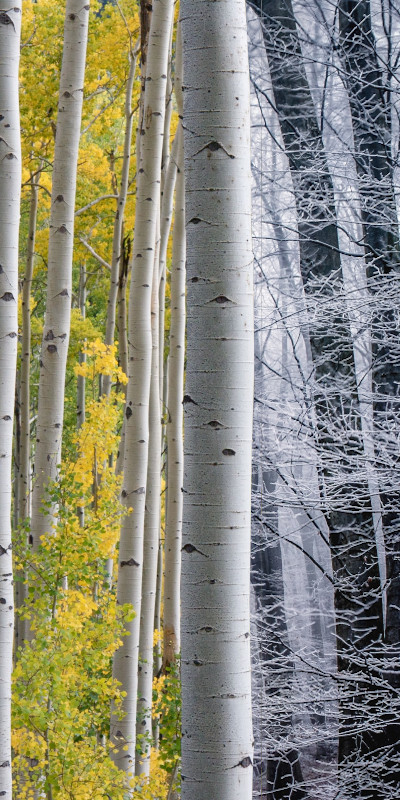
Collage by Storynook Pooka, form public domain photos by John Price (spring) and Simon Matzinger (winter).
The forest was running near them on the heavy wet snow. It was not snowing at the moment, yet tiny particles of ice were building up on their fur. In a rush, a trembling leaf with its broken bits frozen together would finally fall from the stiff birch tree on the ground, but only after touching one’s muzzle.
If you follow the prey path, you can see that trees behave differently. In summer, there is a canopy that protects them from harm whereas in winter, the greenery disappears. This allows precaution and better sight. Nevertheless, when they are running in search of meat, the cánaalah also cast a glance up to the top of the tree trunks to check the growth of cold: if the high branches are brown from their pointy end up to where they connect with the trunk, they can tell we are in the beginning or end of winter; if the puny buds are frozen and the branch wears a white moss, then the cánaalah know it is the sign of middle winter. At the same time, their fur becomes thicker; as they have two layers of it, the cánaalah don’t suffer from the harshness of their survival conditions.
∞
Humans are not aware that each animal keeps the memory of its ancestor alive. Even if people have named species, these animals already had a primeval appellation. Wolves call themselves Cánaalah after their ancestor, the Canid. Cánaalian legends say that Cernunnos, the Celtic horned god, was once lost in a widu1 and because of long travelling, his feet were sore with blisters. It became harder to walk and difficult to give way to reason when out of a sudden, he noticed a crow. Cernunnos knew about its connection with fate and the goddess of war: Mórrígan. She metamorphosed from her animal state and decided to fight the horned god for unethically crossing her path. Mórrígan was known to be a ruthless god. She usually wounded her victims and brought them near death, but did not provide them with the luxury of dying instantly. When the rays of twilight smoothly made their way to the ground through pine needles and behind cones, Cernunnos was disfigured: he was left with no horns, open bleeding marks on his arms; his left leg was broken and he suffered a severe head injury. Suddenly, as the woods were allowing less light to enter their territory, Cernunnos noticed blurrily a striking shadow of a massive animal which he could not identify. This animal was silently approaching him, but Cernunnos could tell that it smelled his reaction: the animal was conscious of the god’s awareness towards it. Cernunnos noticed the hesitation of the animal: it looked as if the unfamiliar scared it. The god felt the difficult decision it made: the animal continued to come closer out of curiosity. At first, Cernunnos was appalled: it was twice as big as him with a tremendous mass of white fur, tawny eyes, long muzzle and a tail that reminded him of the sight of a forest seen from a hill in winter. If you position yourself on a hill in winter, you can notice the symmetry of a row of trees and them allying together to fight natural phenomena by sticking their branches together. Even if these are covered with frost, you can still see tiny brown remnants of the trees. This animal’s tail looked similar: his fur was alert, and even if this was entirely white, you could see grey shades mixed at the root of his fur.
When Cernunnos was convinced that this animal would finally put an end to his life, it started licking his wounds. Then, the animal slowly made it down on its chest and it was pushing its muzzle in Cernunnos’s right arm as a sign for him to climb on its back. The god hardly made his way up. The animal travelled carefully with him on its back and this would snarl from time to time, Cernunnos assuming this to be a warning for other forest creatures he couldn’t perceive. This animal took Cernunnos back to his temple where it received a name and a new title: the animal became the Canid (after its prominent killer teeth). It came to be the protector of the forest and the healer of creatures.
∞
-27 degrees. Frozen trees. Icy air. Glacial ground. Still life. However, motion is challenged by five animals travelling one after the other up the white hill among pines and fir trees. These are the cánaalah. They are currently on a journey to a new territory. According to their mental maps, the new territory they want to conquer is a land of easy and vulnerable prey, as well as secure home for future pups. The five cánaalah respect the hierarchy: the first and the second in the pack are Nákúset (Sun) and Tepkunset (Moon) – the Alpha male and the Alpha female. The following cánaalah are two middle-ranked wolves, a daughter and a son of the Alphas, Mekwék (Red) and Maqtewék (Black). At the end of the pack, there is the Omega member – an odd white cánaala2 who is called Naqalk (Leave)3. Naqalk was a strange figure among these cánaalah. Not only was he an outsider from the pack (he was not one of the Alpha couple’s offspring), but he was also an albino. For these reasons and especially because he was an Omega, he was frequently bullied by the other members of the pack. Unlike other wolves that loved interaction, Naqalk preferred solitude. Because he was constantly mocked by his step-brother and step-sister, as well as by the alpha female, he would only find comfort in his relationship with the alpha male. After all, Naqalk felt that he must protect Nákúset because he had saved his life. Naqalk was the type of cánaala whose nostalgia could be seen in his pink eyes. Albinos are extremely rare among cánaalah. Even if they are born, they do not manage to last a long time in the wild. However, Naqalk was now one year old and his adaptation to nature’s conditions was rather satisfactory.
∞
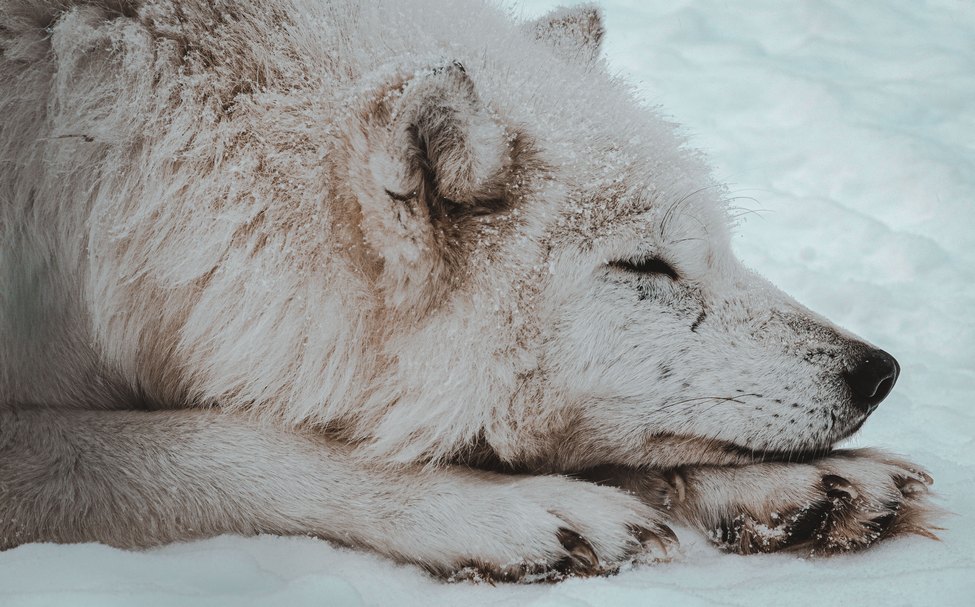
Public domain photo by Joshua Freake.
During the night, when he would coil his tail around his muzzle and ears to keep himself warm, he would remember how he slept next to his mother’s breast; how her survival thumps would assure him of protection and tenderness; how he would play with the other four brothers and sisters, each of them practicing their defense methods. They were only two months old. They were part of a large pack: there were seven grown-up wolves and them. His family called him Wapék (White). One day, when playing next to a lake surrounded by trees with blueberries growing next to their roots, they heard multiple loud cries. Some did not belong to an animal. They seemed like air thumps that hit the walls of your chest and knock you down. The other sounds were the whimpers of animals which were very close to them. Wapék identified the sound to come from the bank of the lake. He ran down and noticed a large animal with a black coat lying with its head in the water. It was their mother. Quickly, with his siblings following, he was next to her and noticed a new shade in her coat: it was a red spot right on her ribs next to the chest where he used to feel safe. He looked more carefully and noticed that all its aunts and uncles were lying around the lake as well: some had their heads on stones; others were shaking, still trying to catch air. Their father was fallen on the roots of an oak tree, with his grey eyes still open. Then, strange creatures appeared. They caught the pups and tried to put them in odd boxes. Wapék managed to escape but he was almost hit with that artificial aerial cry he had heard earlier.
He ran to the woods back to the den where his mother would take care of them. He wept. He was about to howl and announce his loss. Just before this, he heard movement outside the den. He thought that maybe one of his family members had escaped and ran excitedly outside. He didn’t expect to encounter him: it was an unfamiliar cánaala with yellow eyes, grey and red coat and his muzzle smeared with blood, just like the one on his mother’s chest. Wapék was disturbed and afraid. But the grown-up cánaala knew what had happened to the pup: their parents had been killed by humans. He sat down on his haunches and looked at the frightened pup with self-possessed calmness:
‘They are not coming back, you know.’
First, Wapék was afraid to answer and wanted to snarl, but he failed.
‘How do you know?’ said Wapék.
‘Humans are obsessed with wild things. That’s why when they come here, they take everything they can either alive or dead, but never return it.’
‘But why?’
‘It is a way of proving supremacy. We are the protectors of the woods and the healers of creatures. However, we have never managed to protect the woods from humans or heal them from taking what belongs to this land. Every time we get rid of some humans, more come back and they are more threatening to the living.’
‘Aren’t they like us?’
‘No, they aren’t. They don’t consider us equals. We are subordinates, and subordinates must obey whatever their whims are.’
‘Are they coming back?’
‘They will, yes.’
Wapék was terrified.
‘Are they coming back for me?’
The unknown cánaala reacted surprised.
‘The wild is about holding on to life and fighting as well as you can with those who would cause you any harm. You are a special kind, and if the humans noticed this peculiarity about you, they would probably come back for you. Because they knew about your pack, they could find this den very easily and once they find your home, they find you. But this is not going to happen if you choose to come with me.’
Wapék wasn’t sure he understood right. He asked for more information:
‘Excuse me, but where? And who are you, anyway?’
‘My name is Nákúset and I live with my family on the mountain, opposite the lake, near the steep cliff.’
‘But Nákúset, I wouldn’t be accepted. I would be an outsider. My mother taught me about this. The cánaalah that enter a new pack have to work double so they can be treated as part of the pack…’ said Wapék.
‘What is your name, son?’
Wapék was stunned. He barely could tell his name when he heard how Nákúset called him ‘son’. It sounded exactly like his father.
‘Wapék, we are still family in a way or another. If you stay here, you will either starve or be killed. A lonely cánaala can hardly manage on its own especially when winter is approaching. A cánaala should always protect its kind, even if some have other beliefs.’
Wapék had mixed feelings, but he decided to go with Nákúset. He thought at what his mother would tell him. He knew she would always choose the right way to protect him.
‘Are you sure your family will accept me, Nákúset?’
‘They are your family now, too. One more thing, son. I think we should give you a proper name that would say more about your virtues than just the colour of your coat. How about Naqalk?’
‘Naqalk? What does that mean?’ said Wapék actually thrilled about the new name.
‘It means leave. The Canid only gave the name Naqalk to those who understood that sacrifice is sometimes unavoidable. Leaving the land of your family and going to a new territory is not easy, especially when you’re so young, but sometimes it is necessary. Some cánaalah that end up alone like you are now usually die. The pack work is really important for the cánaalah. Naqalk would literally mean that you are a brave cánaala that chose survival over death and thus, a new cánaala was born.’
‘Do you think it suits me, Nákúset?’
‘It certainly does.’
Naqalk would constantly have the same dream: he sleeping in his mother’s coat; he finding his dead family; he hiding from the creatures; he encountering Nákúset and he leaving with him to the new family.
The Alpha female was not happy at all when he saw Nákúset coming with another pup. Tepkunset started snarling viciously at Naqalk and caught Nákúset by the neck. He didn’t answer back, as it is against the rule of the wild for a male cánaala to attack a female cánaala. Naqalk was terrified by Tepkunset. He knew she didn’t like him. One night, when he was sleeping among his new siblings, he heard her say:
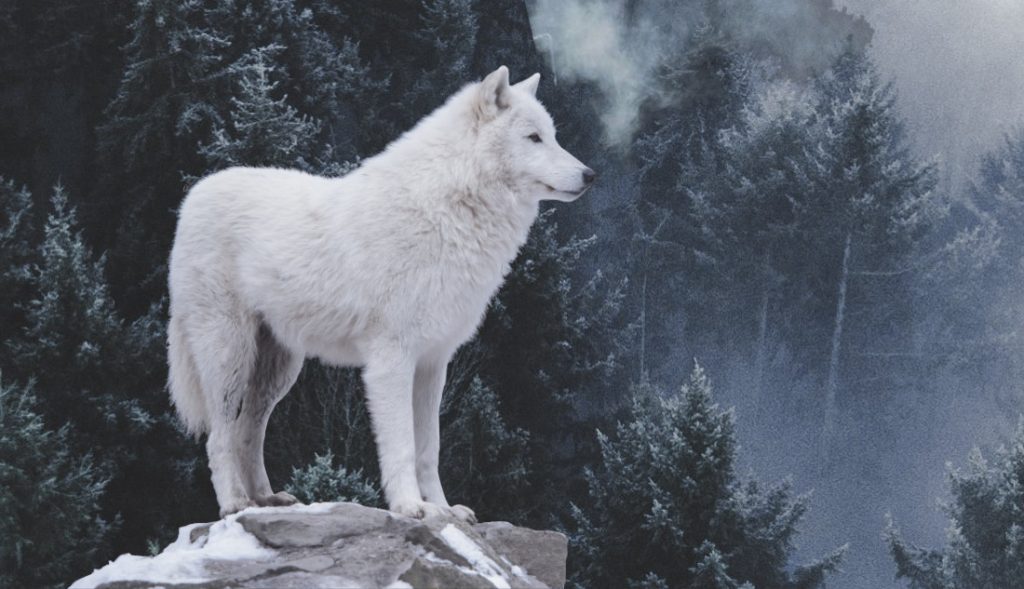
Collage illustration by Adrian Oțoiu. Images from public domain by Christian Grab (background forest) and Philippe Montes (white wolf).
‘But he is an albino.’
Albino? What is that? His mother had never called him an albino.
‘His family had been slaughtered by the humans. What was I supposed to do?’ Naqalk recognized Nákúset’s voice.
‘You went out hunting for your own pups, remember?’ ‘The cánaalah have been given two noble tasks: to protect and to heal. I will protect my kind and I will try to help him heal from what he’s been through.’
∞
Detail from public domain photo by Marek Szturc.
Naqalk spent a lot of time on his own. When he was with the pack again, he tried to take care and educate the new members –– the new pups –– but Tepkunset was usually snarling at him when he was getting too close to the young. Sometimes, when he was fed up with being bullied by Mekwék and Maqtewék, his step-sister and step-brother, he would just go and hunt small animals, like squirrels or birds. When he was by himself, he would spend a lot of time thinking and living in the past. I don’t think I deserve this name. Naqalk – the name of a noble cánaala who understands the wild. But do I understand it? Of course not. I’m sure Nákúset tried to give me a proper education and help me grow into a responsible cánaala, but I failed him. I failed my mother. Where is she now, anyway? I sometimes fancy that she is not really dead and that while I am lying in the sun in our meadow, she is returning from hunting. I’m sure this is not true, but I’m trying so hard to make it as real as possible so I can believe myself. What would she say about my new family? I don’t think they care much about me. But they take care of you, my mother would say. They do, but is it just an act of kindness or an act of pity? I’m a full-grown cánaala now. I’ve been thinking for some time now to talk to Nákúset about my emotions. Does he really care? I guess not. I’ll try.
During that night, they all hunted down a moose. First, the Alphas ate, then Mekwék and Maqtewék together with the new pups and at last, Naqalk managed to have a good meal as well. Before falling asleep, he went and asked Nákúset to give him a moment to talk.
‘What troubles you, Naqalk?’
‘Nákúset, it’s been one year since I’ve left the territory near the lake. I’m a full-grown cánaala now. You’ve been really kind to me, but I think I’ve been enough of a burden already. I think it’s time to be on my own.’ Involuntarily, he gave out a grieving howl.
‘What are you howling about? Why do you want to leave?’ said Nákúset who didn’t expect this.
‘I’m an outcast here. You know that.’
Nákúset snarled at Naqalk when he said this.
‘You are part of this family. Why do you want to desert it? We are here to protect each other and heal wounds of whatever kind. I thought your wounds were healed long ago.’
‘I think I cannot be healed, Nákúset.’
Nákúset jumped and bit him by his muzzle. Then, he calmly got up and licked Naqalk’s ears.
‘If you want to leave the pack and find yourself a mate, fine. You have my blessing. But if you want to leave the pack just to be solitary, you will be just like the others: acting out of foolishness to prove yourself great for no real cause.’
‘No one really cares about me here.’
‘We care for each other because we protect each other. It doesn’t matter who you are as long as you are a cánaala.’
‘Tepkunset said I was an albino in the first evening when I had arrived. It took me a long time to understand, but now I know. Albinos are very rare and they don’t live too much. I will never be as fast as Maqtewék or have such a good sight like Mekwék. I am a burden. And when the food is scarce and you are no longer the Alpha of this pack, I will be cast out. So, I have decided to leave before this happens.’
‘No one will cast you out. You will always have your place in the pack…’
Naqalk was already leaving.
‘I will always have my place as an Omega. The lowest, filthiest and most miserable place.’ And when he said this, he ran among the trees. Nákúset didn’t follow him, as he thought Naqalk would return.
∞
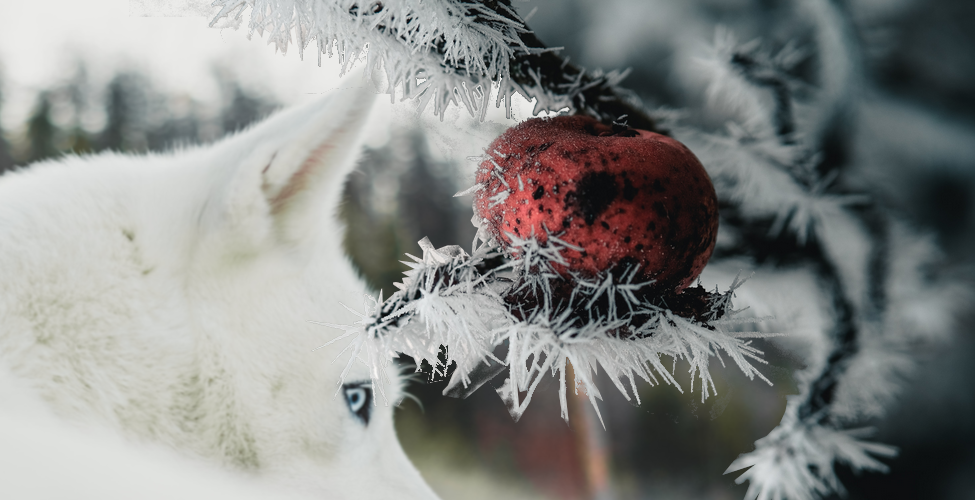
Collage by Storynook Pooka, from public domain photos by Marek Szturc (wolf), and Kevin Mueller (dried fruit in winter)
Naqalk was now in a different land. He remembered all the places where he had lived before: the den next to the lake, then the cave next to the steep cliff. This place was different. It was a very thick forest, still green due to pines and fir trees. Naqalk was moving very smoothly among the frozen Indian grass when he discovered a river running down a valley. He leaped in the clean water and washed his paws of mud. The other side of it looked unfamiliar, but it made him really curious. When he crossed the river to the opposite bank, he discovered new types of trees here. He smelled one of the fallen things from a tree in the snow and realized it was a walnut.
There was a path going up a hill which was half frozen. As he was climbing up, he noticed a small, rather abandoned concrete house. He peered in through the door and noticed it only held a few wood planks placed in a certain way so that they can hold apples and pears. He went out of the house and he was now under a half-fallen quince tree. The tree seemed not to have grown vertically as they usually do, but almost in a diagonal direction. His roots grew chaotically outside the soil instead of growing underground.
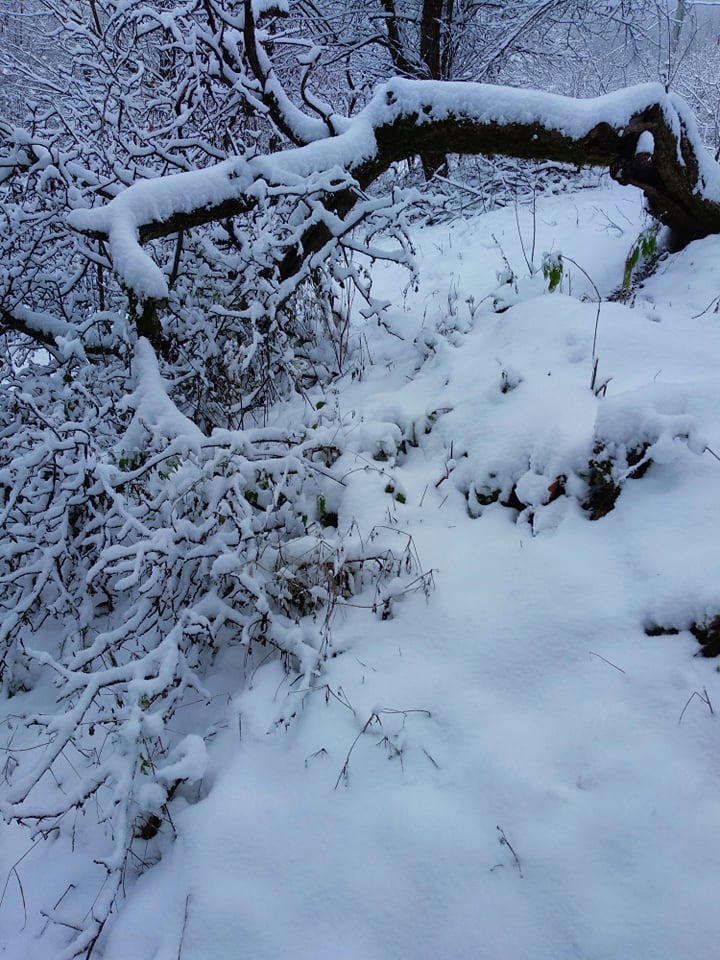
Photo © Selena Acqui
Under the tree, Naqalk noticed a creature raising something in the air and then hitting a piece of wood. This blow would instantly split the wood in two. He was astonished. Suddenly, the creature saw Naqalk and they each analyzed each other. Naqalk didn’t move because he was afraid, but he smelled fear coming from the creature. This tried to come closer to Naqalk, talking in a language he could not understand, but without seeming a threat. Naqalk almost involuntarily started snarling while sitting on his haunches. When the creature put his hand in front of his muzzle, he smelled it but couldn’t identify danger. Then, he just let the creature touch his head. It reminded him of his mother’s caresses. The creature was petting him, but at some point, it went inside the house. So then, Naqalk got up and left the garden of the man who actually went inside the house to bring him something to eat.
Later, while walking in the woods again, he was thinking at this connection between the cánaalah and these creatures Nákúset called humans. I think they are like us. Some of them accept you, some of them don’t. Do they protect each other the way we do? I think yes. I’m sure they smell danger, but they do it in a different manner. Do they hunt food? I know they do, but sometimes it affects the woods. We go in the forest for food but we are also the healers of the woods. We don’t let it suffer, not like them.
While exploring, he discovered an elk carcass that was being torn apart by some ravens. Suddenly, he smelled something approaching him.
At first, he couldn’t tell what it was. It was something growling and howling, but in a different way than he did. Then, he noticed a shadow moving in the distance. He wanted to run, and he did run, but he ended up in a snare. Naqalk tried desperately to free himself, when he saw one of those creatures that killed his mother. Two cries of aerial thumps were heard and a long wailing broke out from the valley of the pines.
Nákúset and the rest of the pack followed his trail when they heard the blows. He tried to smell the air and felt a slight sense of blood and Naqalk. When that happened, he let his tail fall down and led the pack back home. That night, the whole pack howled in mourning for Naqalk. Nákúset felt how he failed to heal Naqalk and because of that, the young cánaala chose to take this deadly path. This incident changed the behavior of the pack. They no longer went in that part of the wood and they have never forgotten Naqalk. They know no oblivion.
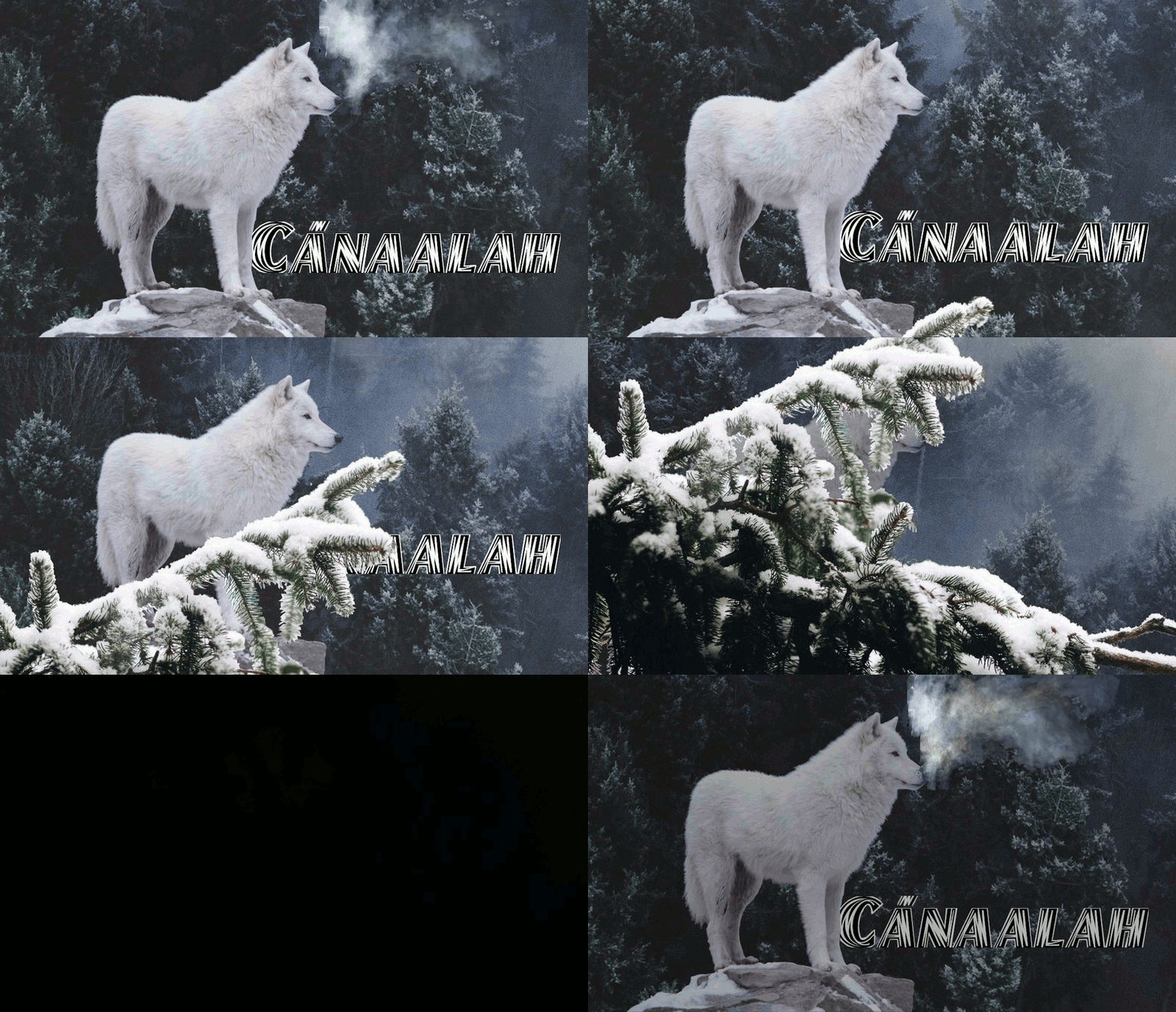
Animation by Storynook Pooka
∞
November 29th, 1985
The trunks of apple trees are all frozen. Some still hold on to their last fruits. As strange as it might sound, I have always liked looking out of my kitchen window and seeing the orchard covered in snow, with trees on which crimson or golden apples would still hang from branches covered with snow. It is November, indeed, but it’s already snowing.
Three days have passed since Cheveyo left. Almost a year since I found him. We had a strange encounter at first. That day, I heard the gunshots near the forest where my cabin was. I took my rifle and ran. Then, from behind a thick fir tree, I saw them: two poachers watching an animal caught in a snare howling and snarling at them. A large, white animal…It was the wolf that came to me when I was chopping wood! I watched the two guys: clumsy, scared, only-driven-by-money people. The wolf was bleeding heavily. On his white fur, he had a thick blood stain. ‘The wound is really deep’, I thought. Then, I heard them:
‘That’s a big wolf… I won’t get closer to him now. Let’s leave him here for a while and hunt down some rabbits or deer.’
‘Are you out of your mind? What if an animal comes and kills it?’
‘Calm down, for heaven’s sake. Look at it! It’s literally shaking with anger and frustration. Too bad for you, wolfie! Come on, Jerry. We won’t go far from here. Just around the places where the snares are. Just imagine catching two more wolves!’
When they finally left, I approached the white wolf. He had caught his hind legs in the iron clench and because of the fright, while trying vehemently to free himself, his paws were all bleeding and his flesh was already visible. When he sensed someone near him, he was already in a lamentable state. He didn’t even snarl; just cast his eyes in the ground. I broke the grip. I looked at it but he didn’t move. I took it up in my arms striving to get back to my cabin.
It took him a whole week to get his health back. That was when I baptized him Cheveyo. It was a Native American name meaning Spirit Warrior. When he would sit on his brown blanket next to the green stove, he would watch me writing. Every time I caught his gaze, I would think that this wolf had seen so much death and pain. At such moments, I would remember a legend my uncle told me when I was a teenager. It was about this horned god that was saved by an enormous wolf. The animal became the protector and the healer of the woods. I always thought whether me saving the wolf could be connected to the wolf saving the god. And then, did Cheveyo know about this legend? I think I’ll never know.
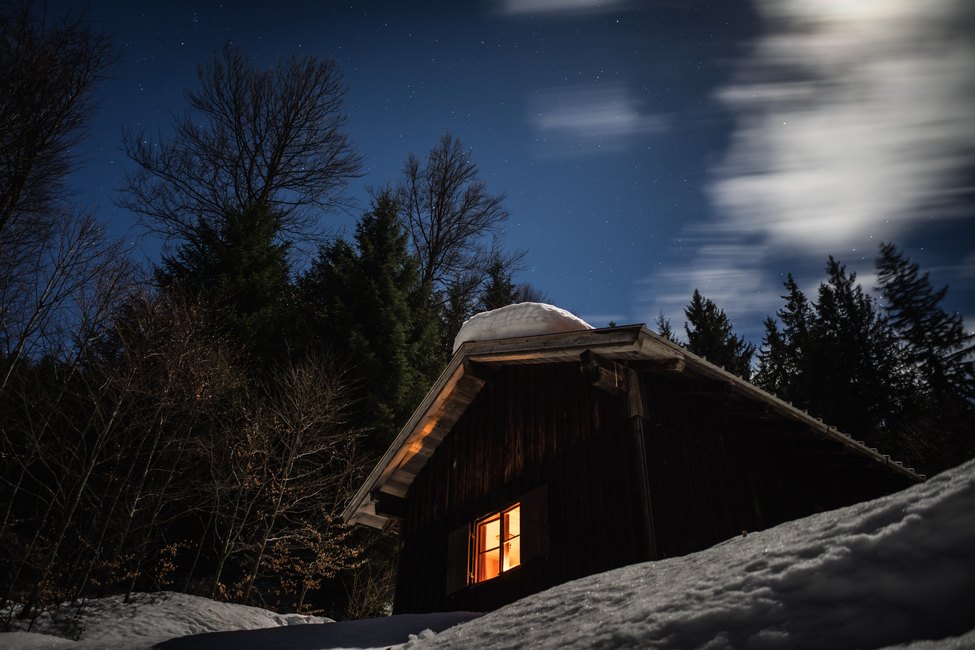
Public domain photo by Patrick Schneider.
I liked the wild. I preferred my solitary cabin to the crowded block of flats in some noisy city. I think Cheveyo was a hermit, just like me. And we liked each other’s company.
But I had to let Cheveyo go. You see, the wild loves deeply and wounds deeply. And Cheveyo knew that. That day, he licked my knuckles when I touched his muzzle and then we hugged. A long, craving hug. Then, I watched how he went down the steep towards the valley of the pines. Before he got into the pine woods, he looked back for a second. I thought he had changed his mind. But he just gave a short howl and lost his track in the unknown.
Do wolves forget? I will surely remember my Cheveyo. Yesterday, when I was chopping wood, I heard the howling. Cheveyo! It was one single howl. ‘Still by yourself, ha?’, I thought. I wanted to hear one more sign of him so badly! But that was it. Then, while taking the axe back in my hands, I stamped on the frozen grass. ‘I hope the wild is good with you’.
∞
Selena Acqui

∞
(Written December 5 2019)
Notes
* Cánaalah is mostly an invented word I made up in order to refer to wolves differently.
1. woods, forest;
2. I thought that the cánaalah with the “h” at the end should be the plural form whereas cánaala without an “h” should be the singular form.
3. Names are taken from the following website: http://www.native-languages.org/mikmaq_words.htm