Squirrels, mice, a chubby kitten, a duck with a bonnet, a hedgehog washing the laundry, or rabbits in clothes – these are some of the heroes that depict the enchanting world of Beatrix Potter. The tiny creatures portrayed by Beatrix Potter in her tales seem to be some of the children’s favourite characters even nowadays, and they were the subject of several adaptations, including cartoons, puppet shows, films, or even ballet adaptation performed by the Royal Ballet.
Beatrix Potter’s first story where the characters displayed anthropomorphic elements was The Tale of Peter Rabbit, published in 1902. Peter was a naughty little bunny that disobeyed his mother’s request and got in trouble because of that. The simple prose and humorous tone of the narrative, combined with delicate watercolour illustrations, have made this story one of the bestselling children’s literature books, greatly enjoyed by both children and parents.
Peter’s story seems to be Potter’s most cherished tale, not only because of the beautiful writing and illustrations, but also because of the wit and naughtiness of the character. Disobeying his mother, Peter went to Mr McGregor’s garden – the same place where Peter’s father had had an “accident” and had ended up in a pie – to eat some vegetables, and eventually, he suffered the consequences of being almost caught by Mr McGregor.
It is this naughtiness of the character that has inspired the recent film adaptation of Potter’s stories. Peter Rabbit is an animation, adventure, and comedy film based on Beatrix Potter ’s classical story and directed by Will Gluck. The Sonny Pictures animation film was released on February 9th 2018 in the USA and won several awards for Best Production Design and Best Visual Effects or Animation thanks to the various techniques and special effects used to animate the animals’ characters and made them interact with human actors.
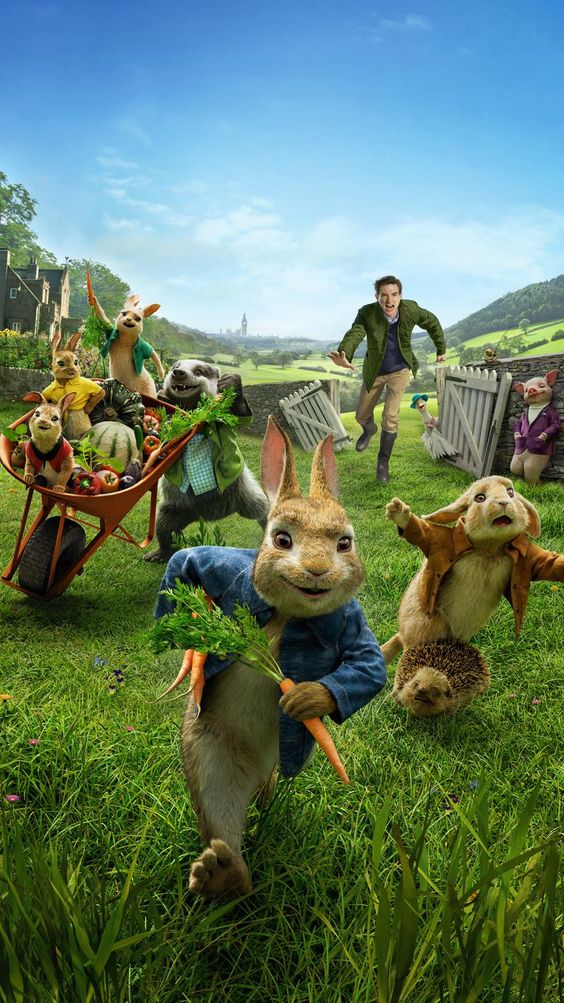
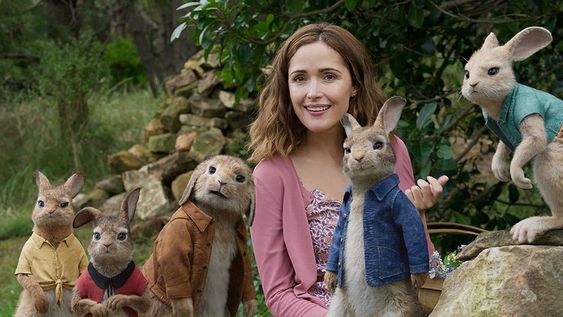
The film tells the story of Peter (voiced by James Corden) along with his siblings Flopsy, Mopsy and Cottontail (voiced by Margot Robbie, Elizabeth Debicki and Daisy Ridley), and his cousin Benjamin Bunny (voice by Colin Moody) who sneaked into Mr McGregor’ garden to steal and eat vegetables. As Mr McGregor died, Peter and his friends thought that they had defeated him, but they found out that a new McGregor appeared. Mr McGregor’s grand-nephew, Thomas (Domhnall Gleeson) inherited the house and garden, and also became interested in his neighbour Bea (Rose Byrne) who loved the rabbits. Bea’s character reminds us of Beatrix Potter in many ways, as she is nothing but a new variant of Mrs Potter (both names with B). Both women loved animals, especially rabbits, and both of them had a passion for painting. Like the old Mr McGregor, Thomas did not like rodents and tried to get rid of them by using animal traps, electric security devices, or even explosives. Therefore, a whole conflict-game between Thomas and Peter arises, causing many funny moments that in many instances remind us of the movie Home Alone.
At the same time, since the new story takes place at the present day, the gentle tone of the classic tale has been replaced by a more dynamic and funny tone, as befits contemporary times. There are several pop-culture references such as jokes and slapstick, scattered in the characters’ speech or even the soundtrack used throughout the film, that makes the story of Peter Rabbit fit for modern times. This new adaptation of Peter Rabbit’s character seems to be different in many ways from the original one. Restless, stubborn, mischievous, whimsy, and yet funny and likeable — these would be the elements that could describe the new Peter. The modern animation of the well-known bunny reminds us of a rebellious child who is ready for new experiences that might be fraught with danger.
Getting into trouble and playing pranks while teasing Thomas, Peter’s character caught attention of a part of the public’s that apparently did not enjoy this so much. The film presents a scene where Peter, together with his other animal friends, attacked Thomas McGregor with blackberries, fruits to which he was allergic, in the hope that he might face an anaphylactic shock and lose the batttle. Because of this scene, the film was considered to be bullying for those who suffer from food allergy. Therefore, there was a boycott of the controversial food allergy scene based on the reason that the film “mocks the seriousness of the allergic disease and is heartbreakingly disrespectful to the families of those that have lost loved ones to anaphylaxis” (Stolworthy, “Peter Rabbit film.”). On the other hand, the scene in question reminds us of Tom and Jerry’s knocking-off-game, when each of them, either Tom (Thomas) or Jerry (the bunnies), tried to defeat the other one by exploiting the opponent’s weakness as a form of self-defense. Therefore, saying that the film depicts acts of bullying or violence might imply the conclusion that films like this one, or cartoons such as Tom and Jerry, would not be not suitable for children due to their violent content. Yet, violence like this, whether uncanny or not, is still loved by children, an abounds in numerous cartoons (even more so in the past) that used to have only a single aim: to amuse the public.
At the same time, some critics did not praise the recent adaptation of Peter Rabbit, because the story resulted in something different from the original tale written by Beatrix Potter. In a Guardian article, Matthew Dennison, Beatrix Potter’s biographer, suggested that the author would not have enjoyed the new variant of Peter’s character, since Mrs Potter “was not exactly possessive, but she had a very clear idea in her head of how the books should be. They came about through really close, careful work. There was nothing accidental or spontaneous about them. And she was a bit beady – she was tough with her publishers on things like how much white space or text there was. Every single detail she really thought about.” (qtd. in Flood, “Beatrix Potter.”)
Nevertheless, whether or not the recent story stands up to the original, whether or not it contains episodes of bullying, the film is still appealing to both children and adults. It is this very naughtiness and the rebelliousness of the protagonist – that always make him cross borders in the search for adventure – that might be the reasons why this film adaptation is so adored by children. By depicting these features of the character, along with the funny moments, the movie tags Peter as a “cool” guy in the eyes of the children, a trait that most of them desired to acquire. However, since the animation abounds in jokes and clumsy actions that provoke laughter, most of the parents relish the film together with their children. Therefore, not only are children enchanted by the latest adaptation, but parents might enjoy it as well, which makes Peter Rabbit a great family film.
Bibliography
Stolworthy, Jacob. “Peter Rabbit film facing boycott over controversial ‘food allergy bullying’ scene”. Independent. February 11, 2018. Accessed on December 5, 2019. https://www.independent.co.uk/arts-entertainment/films/news/peter-rabbit-boycott-food-allergy-bullying-petition-sony-pictures-james-corden-a8205406.html.
Flood, Alison. “Beatrix Potter would not have liked Peter Rabbit film – biographer”. The Guardian. March 9, 2018. Accessed on December 4, 2019. https://www.theguardian.com/books/2018/mar/09/beatrix-potter-would-not-have-liked-peter-rabbit-film-biographer-james-corden.
“Peter Rabbit (2018)”. IMDb. Accessed on December 3, 2019. https://www.imdb.com/title/tt5117670/?ref_=ttpl_pl_tt.
“Peter Rabbit (2018)”. Rotten Tomatoes. Accessed on December 3, 2019. https://www.rottentomatoes.com/m/peter_rabbit_2018.
Mariana Oros